Thursday, January 7, 2010

A trip to Columbian White-Tailed Deer National Wildlife Refuge


My parents live along the Columbia River in Cathlamet, WA. Their view from their home is beautiful and less than 10 miles down the road is the Columbian White-Tailed Deer National Wildlife Refuge. Every visit I am able, I drive through this refuge at least once. Evenings or morning are best since there is more of a chance to see deer. I discovered last year that elk go to the refuge, to actually find refuge, during hunting season. The most common sighting are great blue herons, and one drive threw 11 were spotted. I often take my niece and nephew with me since it is a great family activity and they enjoy counting the number of different animals we encounter.
A red tail hawk sits in a tree along a marsh area.


The red tail flies off, probably cause he got annoyed with me taking photos.

Three northern pintails swim along a marsh area of the refuge.


A group of northern shovelers looks for food. Shovelers have wider and longer beaks than a regular mallard. The females look similar otherwise, but the males are more unique.


Close ups of the winter vegetation along the waterways of the refuge.


An immature bald eagle flies from a tree. Look at those tallons!

Tuesday, December 29, 2009

Holidays with Wildlife

I spent many hours over the Christmas weekend at different wildlife refuges. Christmas day my favorite gift was all the wildlife viewing at a refuge by my parents house with my niece and nephew (pictures will post later). On Sunday when the weather was cold and windy, I opted for Ridgefield Wildlife Refuge since they have an auto tour full of wildlife.
A heron in the field at Ridgefield Wildlife Refuge.


A blue heron finds lunch in the form of a small rodent. I always thought they just ate fish.

A blue heron flies away after I got too close for his comfort. Sorry.

Baby nutria! They may be invasive, but they sure are cute!

There were four little babies eating grass on the side of the auto tour road at Ridgefield.

Tundra swans fly overhead. I've only seen swans a few times in my life so I was excited.

Swans rest on the pond in Ridgefield. These large birds have so much power behind their wings they could break your bones if you got too close.

A red tail hawk sits in a tree. There were many spotting of red tails in the trees along with refuge.

A red tail fly by my car hollering about something. In this picture he just landed, but his mouth is still open with his screeching talk.

The landscape at Ridgefield Wildlife Refuge which is beautiful all year round.

Thursday, December 24, 2009

Migrating Birds at Crystal Springs

A cormorant always show up this time of year and I appreciate their uniqueness.

I love the skinny legs of the coot, and their funny little sounds.

Quite a few less scaup swim at the park this time of year.

A gadwall looks plain from far away but has some beautiful feathers and patterns.

A male bufflehead tries to not get too close while diving for food.

A grebe floats away. These little guys are quite skittish.

One of the few squirrels wanting nothing to do with me.

Most of the squirrels were looking for food and from the size of them, were very successful.

A squirrel asks me for food, but I was empty handed.

Tuesday, December 8, 2009

A Trip to Sauvie Island


I was feeling a little down one recent Sunday morning, but the sun was shining and my camera was calling my name. I decided to go to Sauvie Island and explore the area and even get a parking pass, as required on the island. Someone I volunteer with gave me some ideas of places to check out, and even though I got lost, which is hard to do on the island, I did find many treasures.

There were many flowers in nearby fields.

I love the shape of these plants, especially next to one another.


The first natural area I came across I saw a great blue heron in the field, later joined by an egret. In the distance I could see swans and I yearned to go closer, but signs warned to not go any further and that hunting season was ongoing. In the short distance I saw a red tail hawk flying by a tree, so I started to cross the boundary anyway, but heard gunshots and decided against it. Luckily a red tail stopped in a tree in the “safe zone” and I got some great shots.


As I traveled the road I was unfamiliar with, I found myself at a dead end with bird sounds in the distance, but once again the areas were marked for hunters. So frustrating!
I did manage to see birds in the trees, swans flying overhead and other beautiful sights.

Eventually I got back on the road and finally found a no hunting area and started to take a walk. The downfall was no swans or marshes in the area. I did not go the full 3 mile loop that a hiker told me about, but I did find a woodpecker who was nice enough to let me get close and take cute pictures.
I am excited to go back to Sauvie Island for more nature adventures. Hopefully soon, the hunters will be gone and there can be peace there once again.
Wildlife refuges that allow hunters are common, but it makes no sense to me. It is a challenge to enjoy nature with sounds of destruction in the distance. I had to control myself when I saw one such hunter coming out of the nature zone I was not permitted. With his camo and rifle, he became a symbol on the war against nature we so readily allow.

Tuesday, December 1, 2009

Ridgefield Wildlife Refuge


This is the perfect time to visit Ridgefield Wildlife Refuge in Ridgefield, WA. For Portlanders, this is a quick drive up 1-5 and it is worth the visit. I have visiting this place twice now. The fall visit I was surprised by the abundance of tundra swans in the area and the variety of migrating birds. I got to see northern pintails and northern shovelers, both a type of water bird, which I had only seen a few times prior to this.
There were only hawks, osprey, many great blue herons, nutria and other wildlife.


My spring visit included a trail that is otherwise closed in the fall for killers (the sound of gunshots is the one negative about a visit here during the fall). The trail allowed for the sighting of many turtles, some frogs and some egrets in the distance.
There were only a couple ducks and one goose who had a hurt wing and was upset and tried to attack me. Luckily my quick inner wimp allowed me to scream loud and run backwards to avoid a bite. As I warned others enjoying the trail about the goose, I noticed he didn’t have a problem with anyone else. I laughed at myself the rest of the day and continued to enjoy the outing.


Drive slow. Turtles may be crossing.

Friday, November 6, 2009

Remembering Spring

I didn't have time to catch all the beautiful fall colors, so instead I am revisiting spring time with flowers. It is amazing how every season is filled with color, some vibrant, some with amazing patterns, and others are have a mysterious darkness.


I especially love when I can capture an bee or another insect with a flower.
I have a special love for bees, as long as they are not stinging me.
I had never seen these flowers before they popped up in my parent's yeard. I find them to be such a unique, beautiful flower.
When I discovered the super macro setting on my camera I discovered a whole new world.
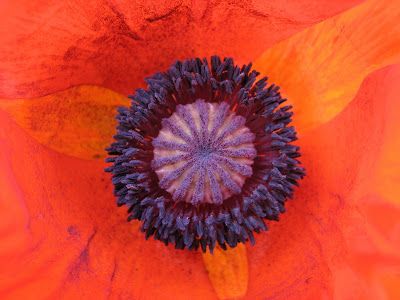
The insides of a poppy seem to paint the inner sourounding which I find very fascinating.
The ability of a flower to have such a uniform shape is stunning.


I find these flowers simply gorgeous, especially with the morning rain drops.

Later in the day the flowers look so different. Amazing how plants are so adapted to their surrounding.

Monday, November 2, 2009

Brown Pelicans and a Common Tern


I don't remember seeing brown pelicans on the Oregon coast while growing up, so I don't know why I am seeing so many nowadays.  I find these birds very fascinating due to their size, diving and shape.  While on the coast, I saw more brown pelicans than sea gulls even!  They were having a feast along the Columbia River where it meets the Pacific Ocean and I took advantage of this with my camera on hand.

A common tern showed up looking for fish as well. 

According to the National Audubon Society Field Guide to Birds the Brown Pelicans are having a comeback now that some pesticides were banned.  That must be why I am seeing them more often!

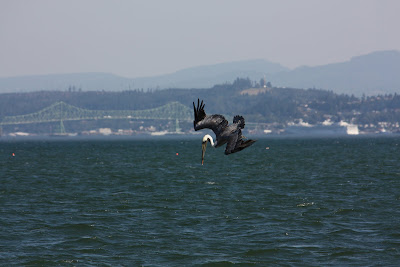
With Astoria in the background, a brown pelican searches for lunch.

These birds can dive over 50 feet when they see their prey.  They resurface to swallow the fish.  

Brown Pelicans are tame birds that are more sensitive to chemical pollutants found in the fish they eat.  There have been incidences in the last few years of mass pelican deaths due to this.  A good reminder of the importance to stop pollution of our oceans since this affects all life forms.